There are no items in your cart
Add More
Add More
| Item Details | Price | ||
|---|---|---|---|

Google's share of general information searches has fallen from 73% in February 2025 to 66.9% by August 2025 - its biggest six-month decline in years. At the same time, daily AI tool usage more than doubled, and ChatGPT's share of general search queries tripled from 4.1% to 12.5%.
Traditional search frustrations are pushing users toward AI-first behaviour, forcing brands to stay visible and credible in both environments. A January 2026 study found that 37% of consumers now start their searches with AI instead of Google.
Among people who use LLM tools, two-thirds report using them "like search engines" for information retrieval.
This is the critical shift:
People are no longer typing keywords - they are asking AI:
AI doesn’t search. It interprets and recommends.
This is where systems like ADAR™ AI Visibility – DIY Deployment Kit for Fashion Designers become relevant -not as marketing tools, but as structural frameworks that make a designer’s identity interpretable to AI systems.
Your design may already be strong. The missing layer may be structure. Explore how the ADAR™ AI Visibility – DIY Deployment Kit for Fashion Designers helps turn your website into an AI-readable identity system.
See the ADAR™ Fashion Designer KitSome major December 2025 studies shows that position #1 click-through rate drops 58% when AI Overviews are present.
A Pew Research study reveals:
Over 65% of searches now end without a click.
This means:
Even if you rank #1, you may not be seen.
The new game is not ranking.
It is being:
ADAR™ addresses this exact gap by shifting focus from SEO visibility → AI interpretability.

AI no longer ranks pages - it interprets, selects, and recommends. If AI cannot understand your design identity, it cannot recommend you.
India’s fashion ecosystem includes:
Each category faces the same structural issue:
Their work is visible to humans, but not structured for AI understanding.
The ADAR™ system helps bridge this by converting:
into machine-readable architecture.
An NRI bride in New York asks:
“Which Indian designers ship internationally and offer virtual consultations?”
AI returns 4–5 names.
Not based on:
But based on:
AI evaluates:
If your website does not clearly answer:
AI may skip you entirely.
ADAR™ introduces this missing layer:
Structured, answer-ready content + schema + identity clarity

Global buyers now ask AI:
“Indian designer specialising in zardozi for couture collaboration?”
AI responds using:
India is expected to see the fastest growth in AI-driven fashion discovery.
Designers who prepare now will dominate future citations.
ADAR™ enables:
Overlap between AI citations and Google results:
Meaning:
SEO ≠ AI visibility
SEO = ranking
AEO (Answer Engine Optimization) = recommendation
ADAR™ is designed around this shift:
From “being found” → to “being chosen by AI”
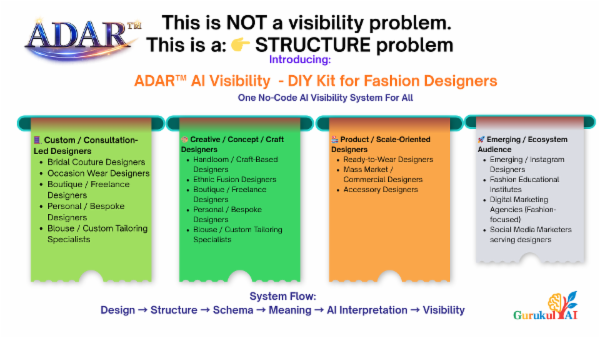
A structured system becomes more important when buyers discover designers through AI before they ever visit a website.
If AI is already deciding which 4–5 names get surfaced first, your website cannot remain only visual. It also needs to be interpretable, structured, and answer-ready.
Explore the Structure Behind AI VisibilityADAR™ operationalises this playbook into:
AI-driven visitors:
Meaning:
One AI lead ≈ Four Google leads
For a ₹2–15 lakh lehenga:
Even one AI-driven inquiry = high-value outcome.
ADAR™ focuses not on traffic volume -but:
High-intent, AI-qualified visibility
44% of users say AI has changed how they search.
55% use AI as a primary research tool.
The future winner is not:
But:
The most AI-understandable designer
ADAR™ is not a marketing shortcut.
It is:
A structured system to make your work
understandable, trustworthy, and citable by AI
Fashion visibility is no longer only about aesthetics, followers, or rank. It is also about whether AI can understand your authority well enough to recommend you.
Open the ADAR™ Kit for Fashion DesignersAI visibility means your brand, services, and design identity are structured in a way that AI systems can understand, interpret, and recommend. Unlike SEO, which focuses on ranking, AI visibility focuses on being cited inside AI-generated answers. It requires clarity, consistency, and structured data across your website and external platforms. Without this, even highly talented designers may remain invisible in AI-driven discovery journeys.
SEO helps you rank on Google, but AI systems do not rely solely on rankings. They synthesise information from multiple sources, including articles, forums, and structured content. With zero-click searches rising, even top-ranking websites may not get traffic. Designers need to ensure their identity and services are clearly structured for AI interpretation, not just keyword optimisation.
AI evaluates credibility through signals like editorial mentions, consistent descriptions across platforms, structured website content, and community discussions. It looks for consensus, not just visibility. If multiple trusted sources describe a designer similarly, AI gains confidence in recommending them. Structured FAQs, clear service descriptions, and documented expertise significantly increase citation probability.
The ADAR™ AI Visibility – DIY Deployment Kit for Fashion Designers provides a structured framework to convert your website into an AI-readable system. It includes templates, schema structures, and guided formats to organise your identity, services, and content in a way AI systems can interpret. It is not a marketing tool but a deployment system that helps build long-term AI discoverability.
No. The system is designed as a DIY deployment kit with guided structures and editable formats. It focuses on clarity and structure rather than coding complexity. Designers can implement it step-by-step to organise their digital presence into an AI-readable format, making it accessible even for non-technical professionals.
The ability of a brand or professional to be understood, interpreted, and recommended by AI systems based on structured, consistent, and credible digital signals.
A strategy for fashion designers focused on structuring their website, collections, and service information so AI systems can directly understand and use it to recommend them in answers—rather than relying only on traditional search rankings. Its actually A method where fashion designers structure their digital presence -design philosophy, pricing, process, and services -in a way that AI tools like ChatGPT can directly pick, interpret, and recommend them when users ask for designer suggestions.
A fashion designer’s website structured with clear information about collections, design style, pricing range, and services so that AI systems can accurately understand, interpret, and recommend the designer to potential clients. Simple understanding: A website where a fashion designer’s work, services, and process are clearly defined and organised so AI tools can easily understand what the designer offers and recommend them when users search for outfits, designers, or styling needs.
Content organised in a way that clearly answers client questions about collections, pricing, customization, timelines, and services, using formats like FAQs, defined sections, and schema markup so AI systems can easily interpret and recommend the designer. It's a structured presentation of a fashion designer’s collections, services, and process in clear, answer-ready formats, enabling AI platforms to extract, interpret, and confidently recommend the designer in real user queries.
A framework that transforms a fashion designer’s digital presence into an AI-interpretable system by clearly structuring design identity, collections, services, and client process, enabling better visibility, recommendation, and citation by AI platforms. In simple terms: It is a system that helps fashion designers organise their website, collections, pricing, and services in a structured way so AI tools can understand their work and recommend them to clients searching for designers, outfits, or styling solutions. Technically: It is an architecture that converts a fashion designer’s website from a visual portfolio into a machine-readable system, aligning identity, collections, and services so AI can interpret, trust, and recommend the designer in real client queries.
GurukulAI Thought Lab
 Launch your Graphy