There are no items in your cart
Add More
Add More
| Item Details | Price | ||
|---|---|---|---|

Bridal designers in India with strong portfolios are still invisible on ChatGPT & Other AI Models. Discover why AI isn’t recommending your studio -and how to become AI-citable using clear positioning, process pages, and an Answer Hub strategy.
ADAR™ AI Visibility – DIY Deployment Kit for Fashion Designers
Why craftsmanship alone no longer wins the first conversation - and what AI-readable bridal designers are doing differently in 2026.
You have 11 years of craftsmanship. Your studio is known in the right circles. You have testimonials that make mothers cry happy tears - the kind that get forwarded in family WhatsApp groups before a wedding.
But when a bride in Jaipur types "best bridal lehenga designer for traditional Rajasthani wedding" into ChatGPT - your name does not appear. Someone with a two-year-old Instagram page does.
This is not a story about talent. You have enough of that. This is a story about a system change that most Indian bridal designers have not been told about - and the ones who have figured it out are quietly capturing your enquiries before you even know a potential client was looking.
Here is a simple experiment. Open ChatGPT, Perplexity, or Google's AI Overview. Type any of these real queries that brides are searching today:
Watch what happens. AI does not return a list of links. It compiles a short paragraph - sometimes just three or four names - with a confident explanation of why each designer is recommended. It describes their specialty, their typical price range, their process, their city, and in many cases their turnaround timeline.
If your name appears, you are winning the discovery moment before the client ever opens Instagram or Google. If your name does not appear, you are invisible at the most critical stage of the bridal buying journey - the moment a woman decides who to shortlist.
This is the AI bridal recommendation gap, and it is growing wider every month.
Because Google SEO and AI citation use entirely different selection criteria. Google ranks pages by keywords and backlinks. AI recommends entities based on clarity, structured content, and machine-readable authority signals - none of which your Instagram profile or standard website typically provides.
This is the core confusion that is costing bridal designers clients in 2026. Search Engine Optimisation (SEO) was built to make your website appear in a list of links. Answer Engine Optimisation (AEO) - the new discipline - is built to make AI confidently include your name in a synthesised response.
The difference is fundamental. When someone Googles a query, they see ten blue links and decide which to click. When someone asks ChatGPT the same query, they receive one composed answer with three to five recommended names. If you are not in that answer, you do not exist for that person at that moment - regardless of where you rank on Google.
Instagram creates social proof for people who already know you exist. AI recommendations create the first point of discovery. These are different problems requiring different solutions.
The designers appearing in AI answers share one characteristic: their digital presence is structured in a way that AI can read, understand, and quote with confidence. Their niche is explicit. Their process is documented. Their specialisations are clearly labelled in machine-readable formats.
Is Your Studio Invisible to AI Right Now?
Run a free test: open ChatGPT and type "best [your speciality] designer in [your city]". If you're not named, the ADAR™ DIY Kit is your starting point.
⬇ Explore the ADAR™ Bridal Couture AI Visibility DIY Kit →
📖 Get the Book ADAR™ Visible To AI DIY Manual for Fashion Designers
Build an AI-Readable Fashion Website in a Day
The modern bridal discovery journey starts with an AI query, not a Google search. Brides use conversational AI tools to compile a shortlist before they visit any website, Instagram page, or studio. Designers who are not AI-visible are eliminated before the shortlist stage - often without the bride even being aware that the designer exists.
The journey looks like this:
Stage 1 - AI Query: The bride asks ChatGPT, Perplexity, or Google AI: "suggest a bridal designer for my December 2026 wedding in Hyderabad." AI returns a shortlist of three to five names with descriptive context.
Stage 2 - Instagram Verification: She opens Instagram to verify the shortlisted names, looks at portfolio, checks recent posts, watches Reels. This is validation, not discovery.
Stage 3 - Website Process Check: She visits the shortlisted designer's website to understand booking timeline, fabric options, pricing range, and consultation process.
Stage 4 - WhatsApp Inquiry: She reaches out via WhatsApp or a contact form - already half-convinced - asking specific questions about availability.
Notice where the cut-off happens: at Stage 1. If AI does not mention you, the bride never reaches Stage 2. Your Instagram, your website, your testimonials - none of it matters if you were eliminated in the first thirty seconds of her search.
Near Indira Nagar in Bengaluru. In a family home in Surat. In a London flat where an NRI bride is planning her wedding back home. The same AI query is being typed. The same shortlists are being compiled. And the same designers who have structured their digital presence correctly are appearing - repeatedly - while talented but AI-invisible designers are consistently absent.
AI recommends designers it can clearly identify (entity clarity), whose process it can explain (process documentation), and whose expertise it can verify through structured question-and-answer content (structured Q&A). Missing any one of these three signals means AI cannot recommend you with confidence - and uncertain AI systems default to the designers they can describe most clearly.
An "entity" in AI terms is a clearly defined, consistently named thing - a person, business, or specialisation that AI can confidently identify and describe. Most bridal designers have an entity problem without knowing it.
If your website says "we do all occasions including weddings, parties, and corporate events," AI cannot form a confident recommendation for a specific bridal query. You are too broad. AI needs to know: bridal couture or occasion wear? Lehenga specialist or full trousseau? Mumbai only or pan-India? Traditional embroidery or contemporary silhouette?
The designers who win AI recommendations have positioned themselves with what ADAR™ calls "niche + depth + machine-readable clarity" - for example, "bridal couture specialist for South Indian weddings, based in Chennai, known for handwoven Kanjivaram integration with contemporary silhouettes."
A bride asking AI about a designer does not just want a name. She wants to understand: what is the consultation process? How long does it take? How many fittings? Can she participate remotely? What fabrics are available?
If this information is not published in a structured, machine-readable format on your website - in plain text, not buried in a PDF or locked inside Instagram captions - AI cannot include it in its recommendation. The designer whose website has a clearly written "How Our Bridal Process Works" page with timeline details will always be recommended over the one whose process exists only in WhatsApp conversations.
AI models build their recommendations by retrieving and synthesising content from across the web. The content they retrieve most reliably is structured question-and-answer format - direct, specific, quotable.
A page that says "We have been creating bridal couture for 11 years and are passionate about our craft" is not retrievable in a meaningful way. A page that directly answers "What is your booking timeline for a wedding 6 months away?" with a clear, structured response is what AI selects and cites.
This is why the ADAR™ framework builds an Answer Hub - a structured set of Q&A pages that directly answer the questions brides are asking AI, positioning your studio as the authoritative answer source for your niche.
Build Your AI-Readable Bridal Authority Hub
The ADAR™ Bridal Couture Kit includes editable JSON-LD schema templates, a 12-page authority website structure, and Answer Hub framework - no coding required.
⬇ Get the ADAR™ Bridal Couture DIY Kit →
📖 Join Free Research Cohort™ - 2026 (Free for First 15 Brands / Websites)
Build an AI-Readable Fashion Website in a Day
The ADAR™ Bridal Couture Kit is a no-code, step-by-step system that transforms a bridal designer's digital presence into a machine-readable authority engine. It includes a 12-page authority website structure, editable JSON-LD schema templates, an Answer Hub framework for FAQ structuring, a Knowledge Hub for design specialisation documentation, audit sheets, and a 30-minute clarity call - all designed to be deployed without a developer or technical background.
Here is what each component does:
Signature Design Hub: A structured set of pages that clearly establishes your bridal identity, specialisations, geographic reach, price positioning, and process for AI systems to read and retrieve.
JSON-LD Schema Templates: Pre-built structured data templates (the technical language AI uses to understand your business) that you fill in and embed. These are the machine-readable signals that tell AI: "this is a bridal couture specialist, this is her city, this is her process, this is what she is known for."
Answer Hub Framework: A systematic approach to building Q&A pages that directly answer the questions your ideal bride is asking AI - turning your studio into the authoritative source for those answers.
Knowledge Hub: Documentation of your design philosophy, fabric expertise, occasion specialisations, and signature style - structured in the format AI retrieval systems prefer.
Audit and Governance Sheets: Checklists to ensure your AI visibility signals remain consistent and up to date as you add new collections and services.
30-Minute Clarity Call: A guided session to position your specific bridal niche correctly before deploying the kit, ensuring your entity signals are precise and differentiated.
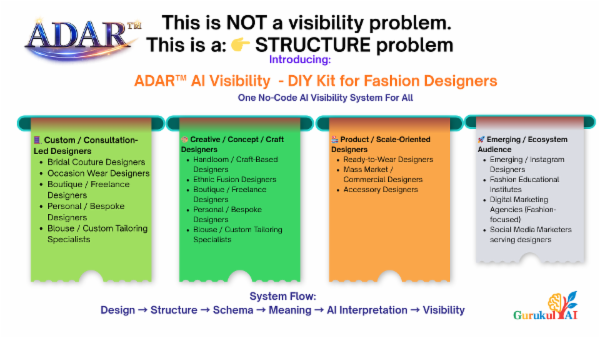
A structured system becomes more important when buyers discover designers through AI before they ever visit a website.
Imagine a bridal couture designer - let's call her Kaveri - based in Bandra, Mumbai. She has been creating lehengas for nine years. Her Instagram has 14,000 followers. She gets referral bookings, but enquiries have slowed and she cannot track where new clients are coming from (or not coming from).
When we test her name in ChatGPT with the query "best bridal lehenga designer in Mumbai for a Maharashtrian wedding," she does not appear. Three other designers do - one of whom has been active for just two years but has a clearly structured website with a bridal process page, an FAQ section, and specialisation descriptions.
After building her Signature Design Hub and deploying the Answer Hub framework, Kaveri's website now directly answers:
Within 8 to 12 weeks of deployment, AI systems that regularly retrieve fresh content begin including her studio in responses to Mumbai bridal couture queries. The quality of enquiries shifts - brides arrive having already read about her process, already aligned with her aesthetic, already pre-sold on her as a candidate.
The volume of repetitive WhatsApp questions drops. The average enquiry-to-booking conversion improves. Not because her craft improved - it was already excellent. Because AI can now explain her craft to the right bride at the right moment.
Your Bridal Identity Deserves to Be AI-Readable
Join the designers who are building AI-citable authority right now - before your 2026-27 wedding season bookings close.
The three highest-priority pages for bridal designer AI visibility are: (1) a Bridal Specialisation Page that clearly defines your niche, city, occasion types, and signature aesthetic; (2) a Process and Timeline Page that answers how your booking, consultation, fitting, and delivery process works; and (3) an FAQ Answer Hub that directly addresses the most common questions brides ask AI before shortlisting a designer. The ADAR™ DIY Kit scaffolds all three with templates, structured data, and a sequential deployment guide.
This is the entity clarity foundation. It must clearly state: what type of bridal wear you create, which occasions you specialise in, which regions or wedding traditions you are known for, your price positioning, your city and whether you serve remote or NRI clients, and two to three sentences that define your signature design language.
This is not a "About Us" page. It is a machine-readable identity declaration - structured specifically so AI can retrieve and accurately describe who you are.
This is the page that converts AI recommendations into warm enquiries. A bride who discovers your name via AI will look for this page to decide whether to contact you. It should answer: initial consultation process, number of fittings, typical timeline from booking to delivery, what remote consultation looks like, how you handle last-minute requests, and your current availability window.
Write it in direct, structured language - short paragraphs, clear headings, specific timeframes. This is the content AI retrieves when answering "how long does it take to get a custom lehenga made?"
The Answer Hub is the most powerful AI visibility tool a bridal designer can build. Each FAQ should follow the AEO format: a direct answer first, context second, and a next step third. Cover questions like:
The ADAR™ Bridal Couture Kit includes a pre-built Answer Hub template with 40 of the most common bridal queries - already formatted in AEO style, ready for you to personalise with your specific process and specialisations.
Your website and Instagram are optimised for human visitors, not for AI retrieval systems. AI tools like ChatGPT, Perplexity, and Google AI Overviews select designers based on structured, machine-readable content - entity signals, FAQ schemas, and process documentation - not on follower counts or visual aesthetics.
Most bridal designer websites are portfolio-first and process-last. They show beautiful images but provide very little structured text that AI can parse and retrieve. Instagram is even less useful to AI - social media content is largely unindexed by AI retrieval systems. To appear in AI recommendations, your specialisation, process, fabric expertise, and booking details must be published as structured, text-based content on your website in formats AI crawlers can read. The gap between having a presence and being AI-visible is precisely where the ADAR™ framework operates.
Audit your website today: does it have a clear Bridal Specialisation page? A written process and timeline page? A structured FAQ section? If any of these are missing, start there. The ADAR™ Bridal Couture Kit walks you through building each one with templates and schema tools included.
SEO (Search Engine Optimisation) helps your website rank in Google's list of links. AEO (Answer Engine Optimisation) helps AI tools include your name in their synthesised answers. In 2026, both matter - but AEO is the higher-priority investment for bridal designers because it addresses the discovery stage that now happens before brides even open Google.
Traditional SEO was built for a world where buyers clicked through a list of ten results. That world is changing rapidly: AI tools now synthesise answers and present three to five recommended names without the buyer having to scroll through links. For high-consideration purchases like bridal couture - where trust, process clarity, and specialisation matter deeply - AI recommendations carry enormous weight. The bride who gets three confident AI-recommended names is very unlikely to go searching for a fourth. AEO ensures your studio is among those three. SEO ensures your website is visible once she clicks through. You need both, but AEO must come first because it determines whether you make it to the shortlist at all.
Start with AEO by building structured authority pages - specialisation, process, and FAQ content in machine-readable formats. The ADAR™ framework does this systematically. Once your AEO foundation is in place, your existing SEO investments become more effective because AI-cited designers also tend to rank better in traditional search over time.
Most bridal designers who complete the ADAR™ deployment begin seeing their studio appear in relevant AI queries within 8 to 12 weeks. The timeline depends on how consistently the structured content is deployed and how frequently AI systems retrieve fresh content from your website.
AI tools like Perplexity retrieve web content in near real-time, meaning new structured content can be indexed and cited within days to weeks. ChatGPT's browsing mode pulls from Bing-indexed pages, which typically index new content within two to four weeks. Building your entity authority - the external citations and consistent naming signals that confirm your studio's identity across the web - takes a little longer, typically three to five months for meaningful improvement. The ADAR™ Kit is designed to build both the technical foundation (schema, structured pages) and the entity signals (consistent naming, process documentation) in a single structured deployment. The Audit and Governance Sheets included in the kit help you track which signals are in place and where gaps remain.
Deploy your Bridal Specialisation Page and Process Timeline Page first - these are the fastest-indexing, highest-impact pages. Then build your Answer Hub. The ADAR™ 30-minute clarity call will help you sequence the deployment for your specific studio situation.
Yes - AI visibility is especially powerful for NRI bridal clients because they rely almost entirely on AI tools and remote research to shortlist designers when they cannot visit studios in person. A well-structured bridal authority hub specifically addressing remote consultation, NRI wedding traditions, and international shipping or fitting processes will position you prominently for this high-value segment.
NRI brides face a specific challenge: they are planning Indian weddings from London, Dubai, Toronto, or Singapore, and cannot easily visit multiple studios for consultations. They rely heavily on AI recommendations, online research, and structured information about how a designer handles remote clients. If your website does not explicitly address "remote bridal consultation," "NRI wedding services," "how fittings work for clients outside India," and "delivery to international locations," AI will not include you in responses to NRI-specific queries - even if you serve this segment regularly. The ADAR™ Knowledge Hub framework includes specific templates for documenting remote service capabilities, which are among the highest-searched bridal designer queries from international audiences.
Add a dedicated section to your Bridal Specialisation Page that explicitly addresses NRI and remote consultation. Use direct language: "We offer full bridal consultation via video call and have delivered to clients in the UK, UAE, USA, and Australia." Include your process for remote fittings and how you handle alterations. The ADAR™ FAQ templates include NRI-specific questions ready to personalise.
The ADAR™ DIY Kit is designed specifically for non-technical creative professionals. No coding skills are required. The kit includes editable templates, pre-built JSON-LD schema files you fill in like a form, and a step-by-step manual that guides you through each deployment stage.
One of the biggest barriers bridal designers face in implementing AI visibility is the perception that it requires technical expertise - developers, coders, or SEO specialists. The ADAR™ framework was designed to remove this barrier entirely. JSON-LD schema, which sounds technical, is essentially a structured form that tells AI systems what your business does. The ADAR™ templates present this as editable fields you complete with your studio's specific information. The 12-page website structure is a content guide - it tells you what to write and where to put it, not how to code it. The 30-minute clarity call ensures your positioning is sharp before you begin building.
Review the kit's step-by-step manual first to understand the sequence of what to build. The recommended order is: complete your clarity call, build your Bridal Specialisation Page, then your Process and Timeline Page, then your Answer Hub. Each stage has a corresponding template. Most bridal designers complete the core deployment in two to three focused work sessions spread across two weeks. Visit learn.gurukulonroad.com to explore the Bridal Couture Kit and begin with the clarity call booking.
Right now, the majority of Indian bridal designers have not yet built AI-readable authority. The window to establish yourself as the default AI-cited bridal couture specialist for your niche - whether that is South Indian bridal wear in Chennai, Maharashtrian couture in Pune, or luxury hand-embroidered lehengas for destination weddings - is open. But it is narrowing.
Every month that passes, more designers discover this gap and act on it. The AI systems that will power discovery in the 2026 and 2027 wedding seasons are being trained and updated right now. The structured content you publish this month becomes part of the retrieval corpus that shapes next season's recommendations.
Your craft does not need to change. Your designs do not need to change. What needs to change is the layer between your work and the AI systems that are now the first point of contact between your studio and your next client.
That layer is exactly what the ADAR™ Bridal Couture Kit is built to construct.
The bride is already asking. Make sure AI answers with your name.
⬇ Explore the ADAR™ AI Visibility – Bridal Couture DIY Deployment Kit
📖 Get the Book ADAR™ Visible To AI DIY Manual for Fashion Designers
Build an AI-Readable Fashion Website in a Day
GurukulAI Thought Lab
GurukulAI India’s first AI-powered Thought Lab for the Augmented Human Renaissance™ -where technology meets consciousness. We design books, frameworks, and training programs that build Human+ Leaders for the Age of Artificial Awareness. The research and innovation initiative by GurukulOnRoad -bridging science, spirituality, and education to create conscious AI ecosystems.
 Launch your Graphy